Across the Water by Rebecca E. Farrell
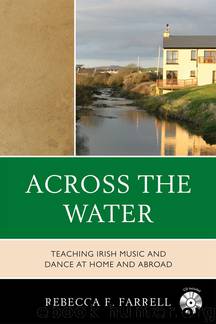
Author:Rebecca E. Farrell
Language: eng
Format: epub
Publisher: R&L Education
Published: 2009-12-31T16:00:00+00:00
Lesson 1
Objective: Students will be introduced to Irish traditional music
Goals:
• Students will be able to perform the traditional song “My Aunt Jane.”
• Students will have an understanding of the basic conflicts and difficulties that have occurred throughout the history of Ireland and their effect on the tradition.
• Students will be able to hold and produce tones on the tin whistle.
Standards:
• U.S. National Standards for Music Education:
1b: Students will sing expressively with appropriate dynamics, phrasing, and interpretation.
6b: Demonstrate perceptual skills by moving, by answering questions about and by describing aural examples of music of various styles representing diverse cultures.
9b: Identify and describe roles of musicians in various music settings and cultures.
Materials:
• Class set of tin whistles
• Tin whistle fingering chart/tin whistle tutorial videos
• CDs
Recorded instrumental selection of the teacher’s choice to listen to on the way into class, preferably containing the tin whistle
Recording of “Milltown Jig”
When I Was Young by Len Graham, and Garry Ó Briain, Pádraigín Ní Uallacháin (optional)
Transcription and accompanying CD (track 1) of “My Aunt Jane”
Transmission process:
1. Introducing the tradition
• As the students enter the classroom, the teacher will have an Irish tune playing on the CD player. When the students are settled into their seats, the teacher will pause the recording and ask them to discuss with their partner what country the music came from. If they need another listening, the teacher will play it again.
• The class will discuss what country they thought the music was from and what made them think this way. They will listen to it one more time to listen for the certain aspects that make the tune Irish (e.g., instruments, tune melody, is it dance music?).
• The students will locate Ireland on a map, and the teacher, using the attached history outline as a guide, will give a brief overview of the general conflicts and difficulties that have occurred in Ireland and affected the music. (Pictures of the country can be found on Irish tourism websites.)
• The teacher will give the students a few minutes to get up and look at the pictures of Ireland that are spread throughout the room before returning to their seats.
2. Learning the tradition
“My Aunt Jane” (singing).
• The teacher will ask the students to listen carefully to the song about his or her aunt. The teacher will tell the students that at the end of the song they will be asked about what they heard.
• The teacher will sing the song “My Aunt Jane.”
Meaning of the song: A common fixture in nineteenth-century Irish life was the “wee shop.” Found throughout the country, this “wee shop” was the precursor to the modern small grocery store. Located in the third room of one of the villagers’ cottages, it sold all the supplies the locals needed (Leyden, 1989). While today this might not be common knowledge among Irish children, “black lumps” is still a term used by some to refer to a type of boiled sweet that much of Europe would call hard candy.
Download
This site does not store any files on its server. We only index and link to content provided by other sites. Please contact the content providers to delete copyright contents if any and email us, we'll remove relevant links or contents immediately.
The Great Music City by Andrea Baker(33662)
Aircraft Design of WWII: A Sketchbook by Lockheed Aircraft Corporation(32382)
Call Me by Your Name by André Aciman(20732)
The Secret History by Donna Tartt(19471)
The Art of Boudoir Photography: How to Create Stunning Photographs of Women by Christa Meola(18758)
Shoot Sexy by Ryan Armbrust(17853)
Plagued by Fire by Paul Hendrickson(17540)
Portrait Mastery in Black & White: Learn the Signature Style of a Legendary Photographer by Tim Kelly(17106)
Adobe Camera Raw For Digital Photographers Only by Rob Sheppard(17092)
Photographically Speaking: A Deeper Look at Creating Stronger Images (Eva Spring's Library) by David duChemin(16799)
Ready Player One by Cline Ernest(15144)
Pimp by Iceberg Slim(14796)
Bombshells: Glamour Girls of a Lifetime by Sullivan Steve(14219)
The Goal (Off-Campus #4) by Elle Kennedy(13965)
Art Nude Photography Explained: How to Photograph and Understand Great Art Nude Images by Simon Walden(13146)
Kathy Andrews Collection by Kathy Andrews(12093)
The Priory of the Orange Tree by Samantha Shannon(9361)
The remains of the day by Kazuo Ishiguro(9223)
Thirteen Reasons Why by Jay Asher(9122)
